
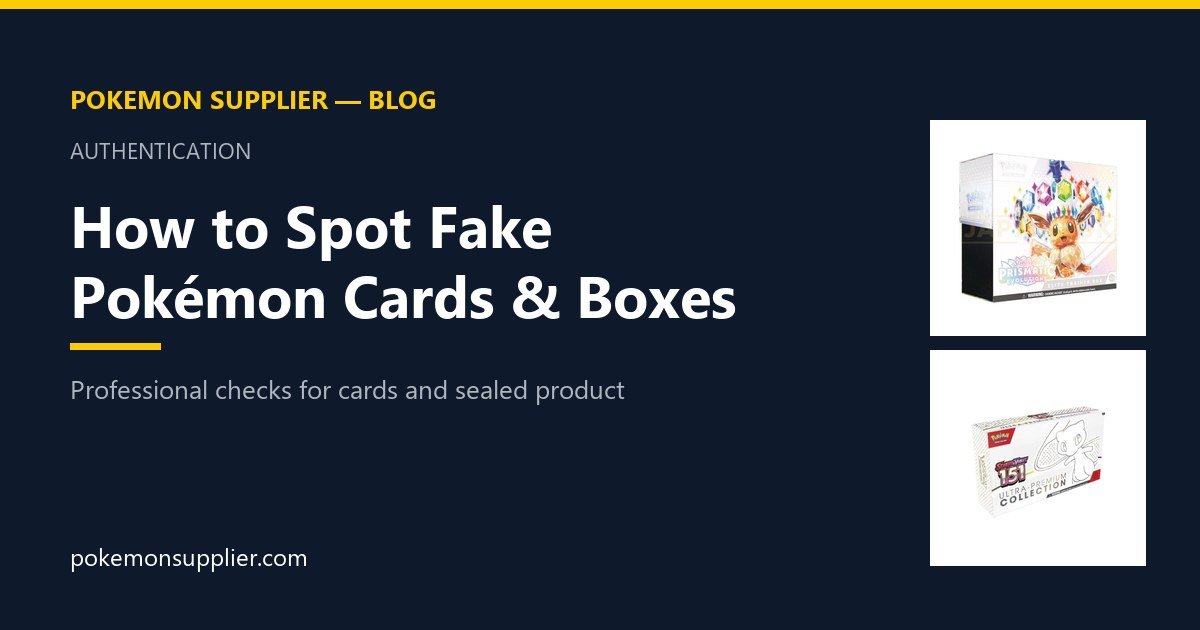
Counterfeit Pokémon product has become dramatically better in the last few years — fake sealed booster boxes now copy shrink wrap patterns, pack art and even weight. Whether you’re buying a single card or a case of boxes, these are the checks we use professionally to spot fake Pokémon cards and sealed products before money changes hands.
Why This Matters More Than Ever
As sealed Pokémon product became an investment class, counterfeiters moved upstream: instead of faking individual cards, they now fake entire sealed boxes, where a single sale nets hundreds of dollars. The most commonly faked items are out-of-print English booster boxes, high-value promo cards and nostalgia-set product. If you buy sealed product in bulk, authentication is a core skill.
Checking Sealed Booster Boxes
1. The shrink wrap tells a story
- Authentic English product uses tight, thin wrap with clean machine folds on the ends and (on modern sets) a printed Pokémon logo pattern on the wrap itself.
- Fakes often have loose, thick or glossy wrap, messy overlapping folds, bubbling at the corners, or heat-gun dimples where the wrap was re-shrunk.
- Japanese boxes are typically not shrink-wrapped at all — a “factory sealed” shrink-wrapped Japanese booster box is itself a warning sign; they seal with a small sticker instead.
2. Check the seams and glue points
English booster boxes have precise die-cut tabs and factory glue. Lifted flaps, glue residue outside the seam line, or a box that’s been opened and re-glued are signs of a reseal — a real box refilled with junk packs.
3. Weigh it
A full English booster box has a consistent weight per set (roughly 730–780g depending on the set). A kitchen scale catches boxes where packs have been searched, replaced or shorted. Ask your seller for the weight before shipping — a legitimate supplier will happily check.
4. Verify the case, not just the box
When buying by the case, authentic cartons carry printed set names, barcodes and lot codes that match the boxes inside. Blank brown cartons with printed labels are how distributors ship mixed goods — fine — but the boxes inside still need the checks above.
Checking Individual Cards
The light test
Real Pokémon cards have a black (older sets) or dark core layer inside the card stock. Hold a card up to a bright light: if light floods through evenly, the stock is wrong. You can confirm on a corner of a known-real card for comparison.
Print quality under magnification
Genuine cards use rosette-pattern offset printing with crisp text edges. Fakes show blurry text, washed-out colors, wrong font weights, or a “pixelated” energy symbol under a phone macro lens.
Texture and foil behaviour
Modern ultra rares have an embossed texture pattern that follows the artwork. Flat, uniformly glossy “textured” cards are counterfeit. Foil on fakes tends to be mirror-bright and rainbow-shifts differently from the real holo pattern.
The feel and flex
Real cards have a firm snap when flexed gently and slide smoothly against each other. Fakes feel either flimsy or oddly stiff, and often slightly wrong in size — measure against a known genuine card: 63 × 88 mm.
Red Flags When Buying Online
- Price far below market. The number one signal. Check TCGplayer or eBay sold listings; genuine sealed product doesn’t sell at 40% under market.
- Stock photos only. Always request photos of the actual product, ideally with a handwritten note or timestamp.
- No traceable payment or tracking. Legitimate suppliers document orders and ship tracked. We photograph orders before dispatch and provide tracking on every shipment.
- Vague sourcing. A real distributor can tell you exactly where product comes from. Ours is sourced from official distribution in Japan and the US — and we state that publicly.
What To Do If You Suspect a Fake
- Don’t open anything further — sealed evidence is stronger evidence.
- Photograph the wrap, seams, and any card fronts/backs in good light.
- Compare against verified product photos, or post to communities like r/PokeInvesting or r/IsMyPokemonCardFake, where experienced collectors respond quickly.
- Open a dispute with your payment provider promptly — timelines matter.
Buy From Sources That Stand Behind Authenticity
Every product we sell — English Pokémon, Japanese booster boxes, One Piece and Weiss Schwarz — is factory-sealed and authenticated before dispatch, with photos available on request and tracking on every order. If you’re ever unsure about product you bought elsewhere, message us on WhatsApp at +15592138546 — we’re happy to give a second opinion.
Frequently Asked Questions
Are fake sealed Japanese boxes common?
Less common than English fakes, but resealed Japanese boxes exist. The sticker seal and box print quality are the main checks — and buying from a supplier who sources directly in Japan removes most of the risk.
Can graded cards be fake?
Counterfeit slabs of major grading companies exist. Verify the certification number on the grader’s website and check that the slab’s label font and hologram match current designs.
Is a weight check reliable on its own?
No single test is definitive — combine wrap, seam, weight and source checks. A box that passes all four is very unlikely to be fake.
