
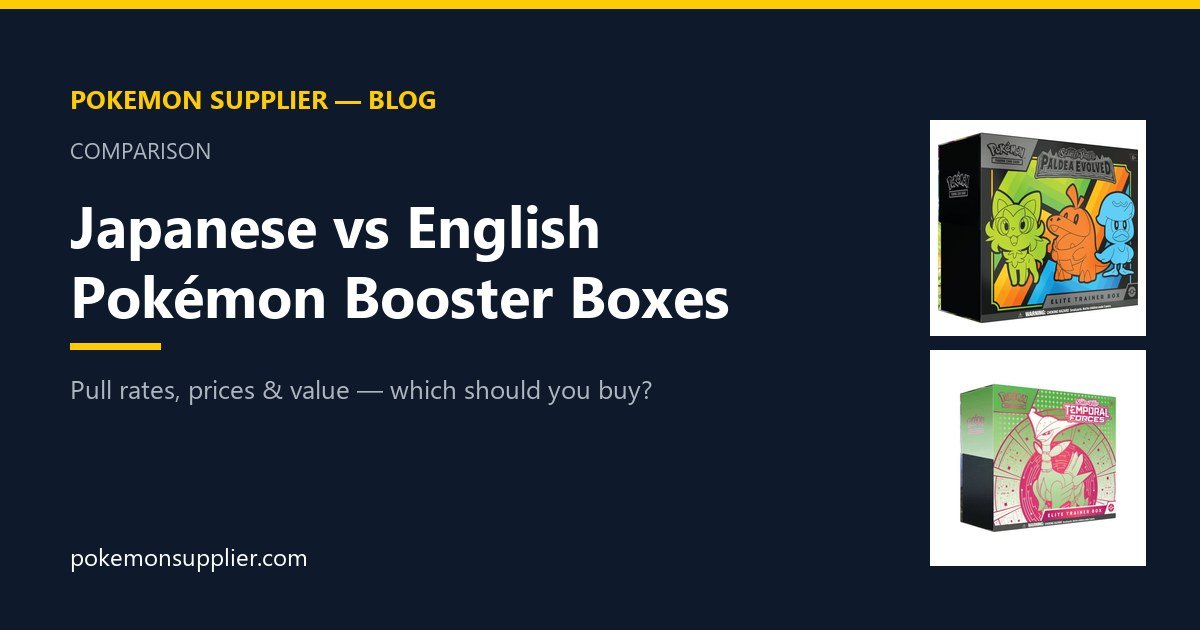
It’s the most common question we get from buyers: should I buy Japanese or English Pokémon booster boxes? Both are authentic Pokémon TCG product printed under The Pokémon Company, but they differ in pull rates, price, print quality and resale behaviour — and the right answer depends on whether you’re opening, selling or holding. Here’s the honest comparison.
The Quick Answer
- Opening packs for fun or singles? Japanese boxes give you more hits per dollar.
- Selling singles in Western markets? English cards command higher prices and a larger buyer pool.
- Holding sealed product long-term? Both appreciate; English special sets have the largest collector demand, while Japanese exclusives benefit from limited print windows.
Box Structure and Guarantees
| Japanese booster box | English booster box | |
|---|---|---|
| Packs per box | 30 | 36 |
| Cards per pack | 5–7 (set dependent) | 10 |
| Typical box price | Lower | Higher |
| Hit guarantee | Most modern sets guarantee an SR-or-better slot per box | No guarantee (pull rates vary) |
| Print quality | Consistently excellent centering and texture | Good, but centering varies more |
That hit guarantee is the headline: with most modern Japanese booster boxes, you know the floor of what you’re getting. English boxes can deliver spectacular pulls — or none — which is exactly why unopened English product carries a “lottery premium”.
Price and Value Per Hit
Japanese boxes are usually cheaper per box, and because rare cards appear at a more predictable rate, the cost per hit is significantly lower. For players and collectors chasing specific art cards (Japanese alt-arts often release months before their English versions), buying Japanese first is the efficient route.
English boxes counter with market size: the English singles market is many times larger, and graded English cards typically sell for more than the same card in Japanese. If your plan is to open, grade and sell in the US or Europe, English product monetises more easily.
Set Availability: Japan Gets It First (and Sometimes Only)
Japanese sets release ahead of their English equivalents — sometimes by months — and some products never leave Japan at all. Pokémon Center exclusives, special box sets and promo cards are only printed for the Japanese market, which is why they command strong premiums from Western collectors. Our Japanese cards section is sourced directly in Japan, including these exclusives.
Sealed Investment Behaviour
Both markets have strong track records once product goes out of print:
- English: flagship and nostalgia sets (the 151-style products, anniversary sets) see the deepest long-term demand because the global collector base is largest. Factory-sealed cases are the preferred hold format — provenance is easier to prove.
- Japanese: shorter print windows mean supply dries up faster. Out-of-print Japanese boxes from popular sets have repeatedly outperformed, though the resale market is thinner and more specialist.
Shipping and Handling Differences
One practical note from the supply side: Japanese product ships in dense, well-packed cartons and tends to survive international freight in cleaner condition — relevant if you care about mint-condition boxes for resale. Whichever you buy, insist on tracked shipping and proper outer cartons; that’s standard on every order we send.
So Which Should You Buy?
If you can, buy both — they serve different jobs. A typical order we prepare for resellers pairs fast-selling English ETBs and booster boxes for weekly revenue with Japanese boxes and exclusives for margin and appreciation. Collectors on a budget almost always get more enjoyment per dollar from Japanese product.
Want current pricing on both? Message us on WhatsApp at +15592138546 — we’ll send today’s bulk prices for English and Japanese sealed product side by side, shipped worldwide.
Frequently Asked Questions
Are Japanese Pokémon cards legal in English tournaments?
In most Western official events, cards must be in the local language or accompanied by a reference — check your region’s rules. For collecting and investing, language is no barrier at all.
Why are Japanese boxes cheaper if the quality is better?
Larger print allocation relative to local demand and a lower retail price point in Japan. Export demand is what closes the gap over time.
Do Japanese boxes contain fewer cards?
Yes — 30 packs of 5–7 cards versus 36 packs of 10. But card count isn’t the metric that matters; chase-card odds per dollar are, and there Japanese product usually wins.
